

5th May 2026
Choosing The Right Ergonomic Seating for Dental Professionals
Most dentists sit for the equivalent of a full working week every single month.
What this means is that ergonomic seating for dental professionals is one of the most important equipment decisions a practice can make and one of the most consistently underestimated.
Research published in the British Dental Journal found that 79% of UK dental students already reported musculoskeletal pain, with lower back pain the most common complaint. A broader systematic review and meta-analysis of dental professionals found the neck and lower back to be the two body regions most commonly affected.
These problems do not arrive late in a career. They begin early and compound through poor daily habits. Choosing the wrong stool is often a big contributing factor.
Why Dentist Posture and Fatigue Deserve More Attention
Dentistry places unusual physical demands on the body. Procedures require sustained static postures, precision hand movements, and close proximity to a reclining patient.
The body’s larger stabilising muscles are held under load for extended periods, while the smaller muscles of the neck, shoulders, and lower back work constantly to maintain position.
When seating does not support a neutral pelvis, the lumbar curve flattens, compressive load increases on the intervertebral discs, and the back muscles strain to compensate.

What Happens When You Choose the Wrong Stool?
Dentist posture and fatigue are directly connected.
An uncomfortable practitioner unconsciously shifts their working position, which degrades access, increases lean, and accelerates the physical toll of the session. Good ergonomic seating for dental professionals maintains the clinical conditions needed to deliver consistent, high-quality work from the first patient to the last.
Not Sure Where to Start With Your Dental Seating?
We can talk through the various dental stool options for your specific surgery. Get in touch and we will help you find the right combination of stool and treatment centre for your team’s needs.
The Key Features of Ergonomic Seating for Dental Professionals
Seat Height and Hip Angle
The hips should sit slightly higher than the knees. This forward pelvic tilt preserves the natural lumbar curve rather than flattening it.
A stool that cannot be raised high enough to achieve this, or that positions the thighs parallel to the floor, will create problems under sustained use. Wide height adjustment ranges matter particularly in practices where multiple clinicians share the same surgery.
Lab Collaboration & Turnaround Time
A seat pan that is too deep forces the operator onto the stool’s front edge, sacrificing any lumbar support.
Look for a waterfall or rounded front edge that reduces pressure behind the knee and supports sustained sitting comfortably. An adjustable backrest should sit gently at the natural inward curve of the lower spine. Not so far forward that it pushes the torso out of position, but firmly enough to reduce disc load throughout the session.
Conventional Stools vs Saddle Stools: How to Reduce Back Pain as a Dentist
A well-specified conventional stool with a forward seat tilt, waterfall edge, and quality lumbar support is a practical option for many operators. It can fall short in terms of seated hip angle, as most traditional designs position the thighs broadly parallel to the floor.
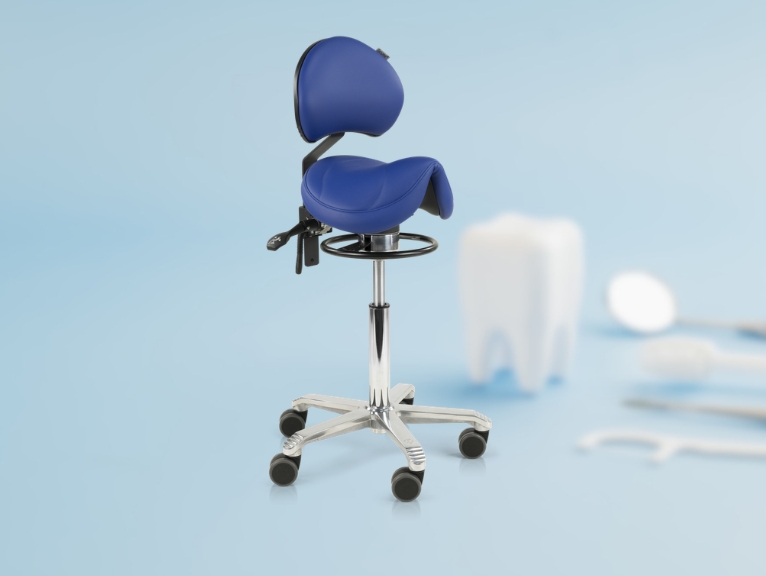
A saddle stool places the thighs at a steep downward angle, bringing the pelvis to a near-neutral position and allowing the spine’s natural curves to stack correctly.
The effect is reduced disc pressure, an engaged core, and a significantly more upright torso without conscious effort. Operators with shorter torsos may find saddle seating allows them to lower the patient and work with a more relaxed shoulder and neck position.
Our dental stool range includes both conventional and saddle-style options.
The Treatment Centre and Choosing Seating for Long Clinical Days
Ergonomic seating for dental professionals does not work in isolation.
The patient chair is an equally important part of the postural equation. A treatment centre with a slim backrest and low-profile headrest gives the operator closer access to the patient’s mouth, directly reducing the need to lean.
Synchronised chair motion allows the operator to maintain their working posture without interruption as the patient is repositioned. Multi-position armrests that fold fully clear speed patient entry and exit and remove a common source of physical awkwardness at transition points.
These details compound across a full day into a meaningful difference in how your team feels by the time the last patient leaves. Our treatment centre range, including options from A-dec and Belmont, is specified with operator ergonomics alongside patient comfort.

Ready to Equip Your Practice With the Right Ergonomic Seating for Dental Professionals?
Ergonomic seating for dental professionals is a long-term investment in your physical health, your clinical quality, and your career.
The right stool, paired with the right treatment centre, is one of the most practical steps a practice can take to push back against that.
Whether you are equipping a new surgery or reviewing what your current setup is costing you, we would love to help. Browse our dental stool range and treatment centres online, or call us on 023 8069 6750 or email sales@currandental.com to speak with a member of the team.
FAQs
What is the best ergonomic seating for dental professionals?
The best ergonomic seating for dental professionals positions the hips higher than the knees, supports a neutral lumbar curve, and adjusts to the individual operator. Saddle-style stools offer strong postural benefits, while conventional stools with a forward seat tilt are a practical alternative.
How do I reduce back pain as a dentist?
To reduce back pain as a dentist, choose a stool that preserves your natural lumbar curve and positions your hips above your knees. Pair this with a treatment centre that provides close patient access to avoid leaning and sustained awkward postures.
Are saddle stools better for dentist posture and fatigue?
Saddle stools are often better for dentist posture and fatigue because they tilt the pelvis forward, reduce disc pressure, and engage core muscles. They require a short adjustment period but consistently reduce musculoskeletal strain across long clinical days.
How does choosing seating for long clinical days differ from general office seating?
Clinical seating must support static postures at precise working heights relative to the patient chair, allow close access, and withstand sustained daily use. General office seating is designed for a desk environment and does not address these specific postural demands.

Further Reading
- Best Design Ideas for Your Dental Practice
- How Dental Practice Design Can Enhance Patient Experience
- When to Repair or Replace Your Dental Equipment
- Dental Spittoons vs. No Dental Spittoons: The Pros and Cons